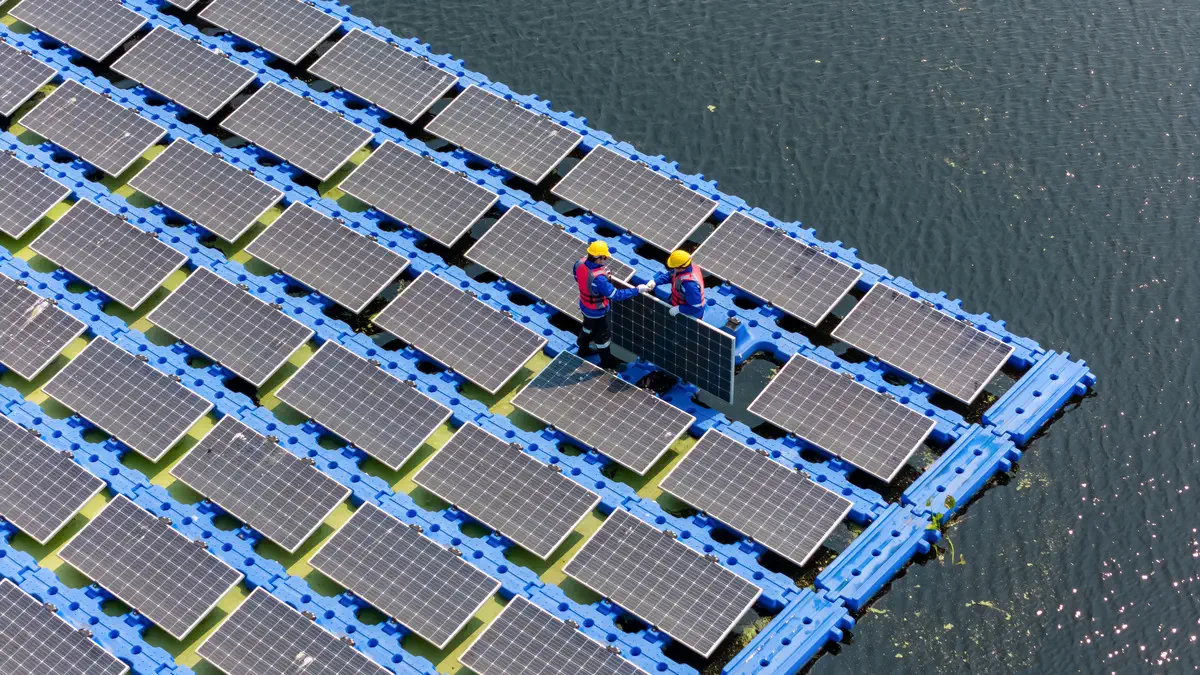
DNV, the independent energy expert and assurance provider, has published two new standards aimed at improving the safety, reliability and long-term performance of floating solar photovoltaic (FPV) systems, supporting the rapid global growth and expansion of renewables.
The new standards, DNV‑ST‑C108 Structural design of floats for floating photovoltaic systems and DNV‑ST‑E309 Station keeping of floating solar photovoltaic systems, are complemented by DNV‑RP‑0584 Design, development and operation of floating solar photovoltaic systems, the world’s first recommended practice on FPV originally released in 2021 and with an update due in June 2026.
Together, the documents provide a comprehensive and aligned framework for the design, analysis, operation and risk management of FPV systems across their full life cycle, from component to system level.

Floating solar is increasingly being deployed on inland and near‑shore water bodies as developers seek to expand renewable capacity while reducing competition for land. As projects scale up, technical robustness and consistency in engineering practices become critical to investor confidence, insurability and long-term asset performance. Indeed, the floating solar market is expected to grow from USD 7.9 billion in 2026 to USD 9.2 billion by 2035, at a CAGR of 1.7%1
“Floating solar is moving from niche applications to large-scale infrastructure,” said Ditlev Engel, CEO, Energy Systems at DNV. “These new standards are designed to help the industry manage risk, improve reliability and enable innovation while maintaining appropriate safety margins.”
DNV‑ST‑C108 defines technical requirements for the structural design and qualification of FPV float structures, addressing both short‑term and long‑term performance. It introduces a flexible, performance-based design approach that aligns engineering and testing requirements with the potential consequences of float failure, while supporting cost‑effective and innovative solutions. The standard includes requirements covering safety classification, design basis, material qualification, structural design, testing and corrosion protection, with particular attention to non‑metallic materials and degradation due to solar irradiation.
DNV‑ST‑E309 establishes principles and methodologies for the design of mooring and station keeping systems for floating solar applications. It provides guidance on design loads, load combinations and analysis procedures, and includes specific requirements for components and system configurations to reduce the risk of failure across the station keeping system. A failure modes, effects and criticality analysis forms the basis for risk assessment within the standard, while safety factors are calibrated through structural reliability analysis to ensure alignment between methodological approach and risk level.
DNV‑RP‑0584 recommended practice brings together requirements, recommendations and guidelines for the design, development, operation and decommissioning of FPV systems. It is intended to be applicable across major global markets and focuses primarily on FPV systems in sheltered inland and near‑shore water bodies, while explicitly defining the limits of applicability for harsher offshore environments where it is only applicable as general guidance or reference document.
The introduction of the two new standards positions the RP as complementary system-level guidance rather than a primary design-level reference.
“The principles and terminology used across the two standards are aligned, providing industry stakeholders with a coherent and consistent set of guidance documents for floating solar photovoltaic systems,” concluded Daniel Pardo Tovar, Global Lead Floating Solar, Energy Systems at DNV “By creating a common technical language and a clear link between component‑level requirements and system‑level guidance, DNV is helping developers, owners, insurers and regulators work from the same foundation.”
Alexis Knipe
Show SEO & AI-citation metadata for this article
DemoEvery article carries this structured metadata so it surfaces in search and can be cited by AI answer engines. In the back end, a person posting fills these in, or the AI layer drafts them.