Innovative Research On Species Response to Global Temperature Change Wins Prestigious 2024 Jennifer Ward Oppenheimer Grant
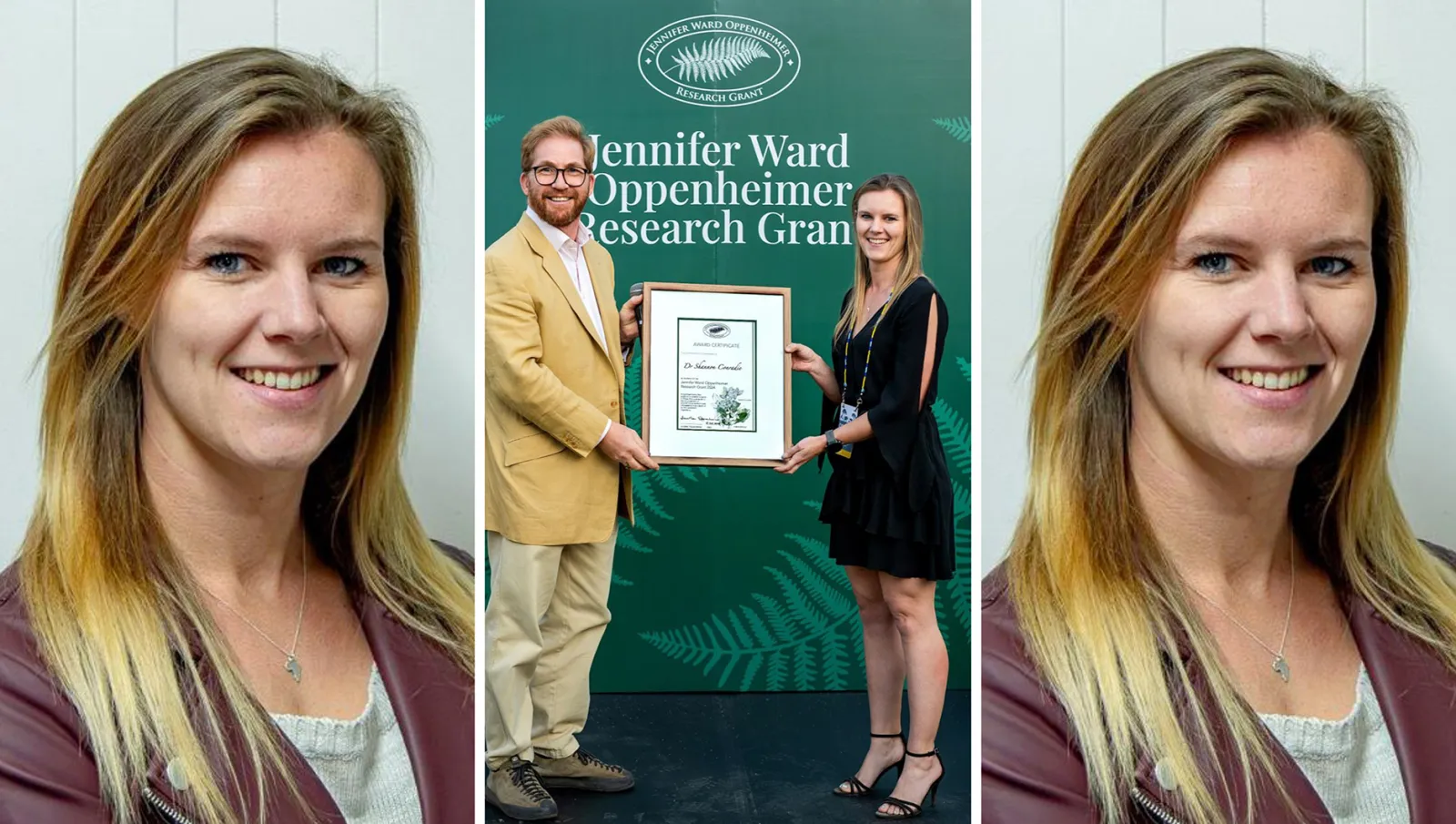
South African ecologist Dr Shannon Conradie today received the prestigious Jennifer Ward Oppenheimer Grant (JWO Grant) for her work using scenario modelling to understand and predict changes in desert birds’ behaviour as they respond to global temperature change.
Selected from a record 630 applications from across 35 African countries and 6 non-African countries, Conradie’s work aims to use science-based, advanced technology and biophysical modelling to understand and predict species’ thermal vulnerabilities, breeding outcomes, and population stability under global change across sub-Saharan Africa. She is currently exploring the survival and reproduction of desert birds under extreme environmental conditions before combining it with mapping birds’ vulnerability to climate change.
This ability to use cutting-edge technology for scenario modelling will help determine how various combinations of global change drivers, such as land use and climate change, may impact species and population structures in terrestrial and freshwater systems. These findings could prove pivotal for conservation and management.
Consequently, Conradie will use the grant to immediately start planning the project, recruiting students with an interest in thermal biology, and further developing it. While her research so far has focused on birds, Conradie foresees the project widening in scope and looking at bats, small mammals, and reptiles.
The Jennifer Ward Oppenheimer Research Grant (JWO Grant) was established in 2019 to honour the legacy of the late Jennifer Ward Oppenheimer, a pioneer in African education and environmental science. Since its inception, the Grant has been instrumental in advancing vital research initiatives across the continent and continues to grow in popularity amongst early-career scientists in Africa.
Upon receiving the award, Dr Shannon Conradie said:
“Receiving the prestigious JWO Grant will empower me to keep building on the skills I have in biophysical-ecology and develop further expertise in remote sensing and thermal drone technology.
But more than that I hope this research will help further our collective work to halt and reverse biodiversity loss. This work can highlight vulnerable species and habitats, allowing us to implement conservation measures with precision. And crucially it can also highlight systems that are doing well and inform best practices – and with nearly 1 million species currently facing extinction globally, the need for research-driven interventions has never been higher. It really is an honour that the Oppenheimer family have seen the value of this research and will be supporting its continuation”.
To mark the occasion Jonathan Oppenheimer, Executive Chairman of Oppenheimer Generations, reiterated how the JWO Grant is working to drive real impact and will continue to do so:
“Over the last six years, we have received incredible applications from across the African continent and our researchers have continued to push the envelope by submitting groundbreaking research projects which tackle diverse subjects and aim to provide innovative solutions to some of Africa’s biggest challenges”
Dr. Duncan MacFadyen, the Oppenheimer Generations Research and Conservation Head also shared his enthusiasm for Dr Conradie’s work;
“What is particularly exciting about Dr. Conradie’s project is the interdisciplinary approach to understanding how animals respond to climate change through the linking of physiology, behaviour, and physics to inform wildlife conservation under global change. We are really looking forward to seeing her work develop and drive impact”
steven
Show SEO & AI-citation metadata for this article
DemoEvery article carries this structured metadata so it surfaces in search and can be cited by AI answer engines. In the back end, a person posting fills these in, or the AI layer drafts them.