Organisational leadership and management of complex digitalisation projects

In today’s fast-evolving technological landscape and interconnected global economy, organisations face the challenge of navigating complex digital transformation initiatives. The article by Professors Brane Semolič and Pieter Steyn, published in the April 2023 issue of the PM World Journal, explores the leadership and management of complex, collaborative digitalisation projects and programmes.
Drawing on extensive experience, the authors examine the multifaceted challenges and strategies necessary for successful organisational digital transformation. Their insights offer valuable guidance for organisations and professionals aiming to excel in the digital era.
“Management and Leadership of Complex Collaborative Digitalisation Projects and Programs”
Prof Dr. Brane Semolic (Slovenia) and Prof Dr Pieter Steyn (South Africa), LENS Living Lab & Cranefield College
Abstract
Industry 4.0 and the digitalisation of business and society remain a main challenge of modern times. New and advanced key technologies enable the introduction of entirely new business models that provide opportunities for better meeting the needs of users, entrepreneurs, investors, business partners and society. The complexity of emerging business cases requires collaborative partnering by all relevant value chain stakeholders operating in the business ecosystem. The related research, development and transformation initiatives are done through research innovation and development (RID) projects and programs. There is an urgent need for collaborative RID projects co-organized and performed by teams of value chain business partners. These complex collaborative projects need a holistic approach, organisational synergy and outstanding leadership to be successful.
Introduction
Mataitsane (2019: Online), refers to the problem where digital transformation is not simply the implementation of ad hoc projects or switching to new technologies such as artificial intelligence (AI), but rather it is an organisation-wide transformation effort to change the business into an agile, data-driven, responsive organisation for the clients. Importantly, he points out that bureaucratic silos and a belief that transformation is someone else’s problem are key inhibitors to achieving digitally mature organisations. Figure 1 illustrates the five stages for successful digital transformation an organisation should follow for digital transformation to become its living DNA (Saldanha, 2019: Online).
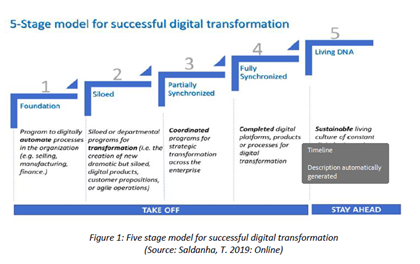
Akamai (2019: Online) avers that to achieve digital maturity the organisation’s operations should be shaped around the correct digital tools. A drive to focus on customer experience delivers the demand for agility and access. The push toward digital maturity can no longer wait if organisations wish to remain sustainable in future. Prof Steyn and Prof Semolic (2018:8), citing Kane (1989), define digital maturity as converting the organisation to compete effectively in the increasing digital ecosystem. Maturity exceeds simply implementing new technology by aligning strategy, workforce, culture, technology and structure with the expectations of the customer, employees and partners. Digital maturity can thus be seen as an ongoing process of adapting to a changing landscape.

Organisations require an effective digital transformation strategy to remain relevant. Benefits of digital transformation include an improved customer experience, higher productivity, faster time to market for products, brand recognition, higher profitability and an overall responsive and agile team. Digital transformation in complex collaborative RID project work is critical for increasing the speed of transactions, saving time, and ensuring customer convenience whilst maintaining a higher level of financial security. Moreover, key enabling technologies assist with real-time tracking of transactions and performance monitoring.
➢ Innovation. The process of creating value by doing the same things better.
➢ Digitisation. Converting analogue information into digital formats or platforms.
➢ Digitalisation. Use of digital technologies to change a business model and provide new revenue and opportunities.
➢ Digital transformation. Strategically planned change to the organisation to stay relevant in a competitive marketplace by leveraging technology.
The path of digital transformation for an organisation is illustrated by Jisc (2020: Online) in Figure 2 as follows:
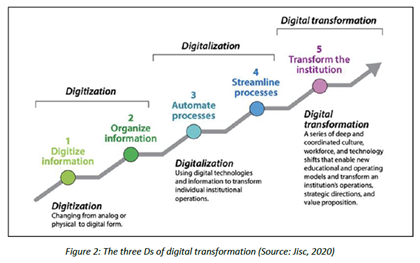
At the time of the C19 pandemic breakout, organisations globally found themselves at some level of Industry 4.0 adoption. The following levels can describe digital transformation:
To exploit innovative technologies for the benefit of all stakeholders requires a profound understanding of how these novelties will affect personal and business lives, organisations in developed and less-developed countries, and how they will reshape organisational landscapes, and societies and culture. It is vitally important to gain a holistic understanding of the risks involved and to plan appropriate solutions for the timely mitigation of the risk and associated complexity. This has hardly ever been done on time in the past, despite having had ample opportunity to critically peruse existing business models and to act to prepare and empower people for the looming threat of transformation and change. Unfortunately, organisations traditionally resist strategic organisational and behavioural transformation and change, often to their substantial detriment.
In 2014, PricewaterhouseCoopers declared (PwC Report, 2014) that the Fourth Industrial Revolution, which is characterised by increasing digitisation and interconnection of products, value chains and business models, has arrived. The researchers recognised that the globalised industrial environment was becoming increasingly dynamic, complex, and high-tech, but that new key enabling technologies (KEBs) were providing opportunities for the introduction of new market services and for upgrading existing products through innovative services and business models. It became clear that to achieve a competitive edge, organisations would need to focus on their key competences and develop both technological and organisational excellence.
Challenges caused by rapid technological development and emerging global energetic, ecological, economic, political, and social crises require partnering and collaborations between industry, academic, political, and civil society partners. The context, extent, and complexity of these challenges gear emerging strategies with entrepreneurial, political and social agendas to foster partnering and collaboration needs. Moreover, new digitalised and digitised products, services, technologies, emerging industries, new business models, organisation systems, projects, etc are by themselves largely complex (Semolic & Steyn, 2018). These challenges stimulate the redefinition of existing and the development of new services and value chains, affecting the need for new corporate competencies and culture change.
Rise of business complexity
Michael Simmons (2018) claims that he found studies independently conducted by four of the greatest thinkers of modern times that came to the surprising conclusion that many of the world’s top entrepreneurs, like Bill Gates, Steve Jobs and Elon Musk, along with some Nobel Laureates, possess a rare skill called “integrative complexity.” Integrative complexity is the ability to develop, and hold opposing traits, values, and ideas and then integrate them into larger ones (Semolic & Steyn, 2018).
Solving the challenges of integrative complexity is a demanding task already at the level of a single organisation. This requires the cooperation of various professions and business functions involved in the organisation’s supply chain and total value chain. Typical business cases of such development projects and programs demand the identification and implementation of complex – interwoven technological and business scenarios, which require the participation and support of various stakeholders involved in the performance of technology and business processes. Significant challenges stem from emerging inter-organisational value chains’ collaboration and partnering with collaborative RID 3 projects and programs (known as “RID projects”).
Partnering in RID digitalisation projects occur when two or more participant organisations are involved. In such projects, different, independent (not formally connected) organisations are partnering and collaborating on jointly identified and defined collaborative project business cases (CPBCs) with their own individual business needs and expectations. The core business drivers for such partnering and collaboration efforts are:
- Limited capabilities (competencies, technology, specialisation, experience, etc) and resources (human, equipment, financial) for planned applied research, innovation, and development efforts.
- Needs for sharing project costs and risks in pre-competitive industry research projects.
Needs for the joint innovation ecosystem capacities development, or requirements of the external project-funding or co-funding organisations (different local, regional, national and international project funding agencies).
RID projects are usually overly complex and need the good understanding, orchestration and support of all project stakeholders in all project life cycle phases (Semolic & Steyn 2018). The complexity of the collaborative business cases of digitalisation RID projects has multiple facets. The integrative complexity of such projects must be observed from the following aspects (Semolic, 2018; Steyn & Semolic, 2019):
- Business complexity – addresses the complexity issues of the industry in question, value chain and business processes complexity, project or program business case complexity, business maturity complexity and industry stakeholder complexity.
- Technology complexity – addresses the issues of products/services technology complexity, engineering technology complexity, project business case’s technology scenarios complexity, complexity of business processes technologies, technology infrastructure complexity, and value chain innovation ecosystem complexity.
- Organizational complexity – addresses the complexity of the inter-organizational value chain coordination system, the complexity of the corporate organization structures, the complexity of business processes, and the complexity of corporate management and governance systems.
- Behavioural complexity – addresses the complexity of the participating partners’ competencies and mindsets, leadership, and corporate culture complexity issues.
This paper deals with corporate digitalisation RID projects’ challenges from the views of business, organisational, and behavioral complexity aspects.
New digitalisation applications and systems are mostly developed and introduced through RID projects, usually sponsored and co-financed by various public funding programs. Undoubtedly, technological aspects are vital for success from a technical point of view.
Digital maturity is about adapting the organisation to compete effectively in an increasingly digital environment.
However, suppose they lack partnering organisations’ management and governance support to provide the required accompanying organisational changes or insufficient stakeholder support. Projects can face significant problems and even not achieve expected goals in such cases.
Business complexity of digitalisation RID projects
In practice, situations often occur where people are not completely satisfied with their achievements upon completing RID projects. This is often the case in large complex digitalisation RID projects with many partners and other stakeholders. The focus is often mainly on the technical aspects of new technological solutions, while organisational and behavioural changes are not addressed adequately.
This problem is due to absence of new business model implementation and related organisational changes required as enabled by new digitalisation technologies. Digitalisation projects must be addressed holistically while considering technical, organizational, and behavioural aspects leading to strategic transformation and change.
Figure 3 depicts a portfolio of interrelated corporate processes that must be holistically addressed in a digitalization RID project’s business case. These processes are (Semolic, 2022):
- Technology value chain. Processes and functions related to the technologies of product or service operation, and the technological processes of their realisation;
- Business value chain. Business functions, processes and activities that enable and support the implementation of the technology value chain and the realisation of business goals.
- Management processes. Are related to planning, organising, providing resources, leading and controlling the technology and business value chain processes and securing adequate effectiveness and efficiency of all operations.
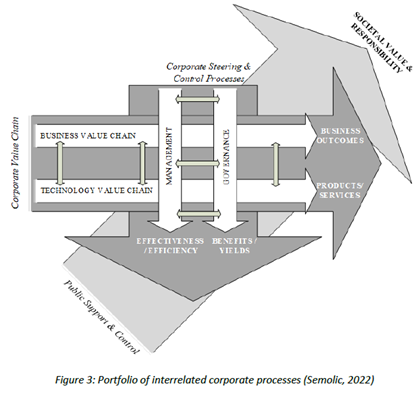
Governance processes – according to ISO 21500 governance provides principles, policies and the framework by which an organisation is directed and controlled.
- Processes of public and societal support and control – compliance with the legislation and rules of the external co-financier(s) and the provision of the public good.
Technological and business processes are part of the corporate value chain, steered and controlled by management and governance processes. All corporate processes must be consistent with the rules and procedures of the public administration and the society it supervises.
The integrative complexity of described RID’s projects and their business cases needs to be addressed holistically, considering all the processes mentioned above and the needs of their stakeholders.
Complexity of partnering RID project organisations
In addition to paragraph 2 regarding organisational complexity, the importance of challenges brought by project partners, their specific business needs and expectations, their corporate organisational structures, and their capabilities must be addressed. These aspects need to be incorporated, documented and harmonised in the collaborative project business case (CPBC).
The primary purpose of the CPBC document is to provide guidelines for collaborative RID project governance, coordination and management toward achieving project goals. The CPBC is a master-baseline planning document of collaborative RID projects, which needs to be managed and updated during the project life cycles. It integrates and harmonises individual partner project business cases (PBCs) into the overall project goals and objectives. Moreover, it define inputs for scope of work and expected deliverable definitions. Figure 4 illustrates the matrix project organization of a collaborative RID project.
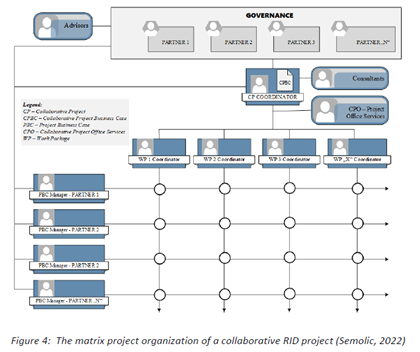
The RID project coordinator is appointed by the leading project partner, the project initiator. The coordinator’s responsibility is to prepare the project charter based on the collaborative project business case (CPBC) compiled by participative project partner representatives. The RID project coordinator collaborates with the partner representatives to appoint the RID project team member roles and responsibilities. Each project partner must appoint an authorised project coordinator responsible for the management of their own partner project business case (PBC). Moreover, representatives from collaborative partners and external project co-funding organisations constitute the collaborative complex RID project governance body members. It can be concluded that complex collaborative digitalisation RID projects are organisationally highly demanding and require astute coordination and support from all participating partners.
Behavioural complexity and leadership of RID projects

Behaviour and mindsets
According to Professor Otto Scharmer of the Massachusetts Institute of Technology (MIT), too many outdated Industry 2.0 and 3.0 mindsets still prevail in organisations. He argues that one cannot solve current 4.0 problems with 3.0 and worse mindsets. The new millennium has developed into an Industry 4.0 connected-complex-whole-ecosystem. But thinking is generally way behind, stuck in 2.0 and 3.0 based on scarcity, fear, competition, and control.
The only way to truly change is to upgrade the awareness of the participants in a system. Outdated paradigms and beliefs are the biggest threats. Schamer’s Matrix of Social Evolution illustrated in Figure 5 shows how people behave on each level, whether in an individual (micro: attending), a group (meso: conversing), an organisation (macro; organising) or global system (mundo: coordinating). The 4.0 ecosystem awareness indicates what is actually required in today’s world.
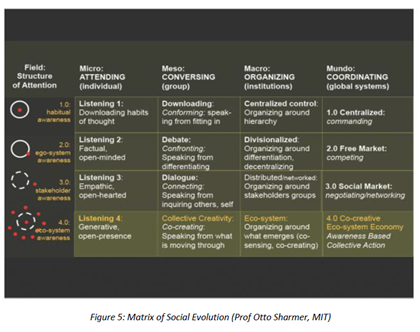
Scharmer opines that the biggest leadership challenge today is that awareness is fragmented and focused on ego: “what’s in it for me?” Real leadership work is to help people see the whole and change their perspective from “me” to a systems view: “we”. Back in the past, leadership 0.0 was communal and shared in the community.
1.0 is top down in a hierarchical pyramid, aligned with centered organisations.
2.0 is delegation and competition, aligned with decentralisation in organisations.
3.0 is participatory, relational leadership in a networked, stakeholder environment.
4.0 leadership is co-creating with the wellbeing of the whole in mind!
Professor Scharmer believes the questions to answer are: “Where is your organisation at this point? And where are you?”
The above are the main challenges of contemporary organisations and their environments. Modern effective and efficient virtual dynamic learning organisations (VDLOs) have become more cross-functional, flexible, agile and virtual over time. Their boundaries are blurred and not closed as they were at the time of the early industrial eras. In the Industry 4.0 economy it is profoundly important to master the management and leadership complexity challenges of the complete range of project- and supply chain portfolios. Of particular interest are the Supply Chain Portfolio collaborative research, innovation and development (RID) projects, its innovation ecosystems, and related emerging competences.
In recent years the world is witnessing simultaneous and profound changes in all areas of private and public corporate activities. Organisational and private lives are becoming highly volatile and value-driven, demanding continuous innovation and learning. These changes, caused by the inflow of new digital key enabling technologies 4 intertwining with peoples’ daily lives, influence the way organizational activities and daily chores are performed (Semolic and Steyn, Sept. 2017). Moreover, this is only the first taste of more dramatic changes in the years to come.
The key research findings in the 2016 Global Industry 4.0 Survey Report, published by PWC (Geissbauer, Vedso, Schrauf, 2016), reflect the following needs or situations:
– Industry 4.0 moved from theories and strategies to real investments and actions.
– Companies that successfully implemented Industry 4.0 no longer need to choose between focusing on a better top or bottom line. They can improve both at the same time.
– Deepen digital relationships with more empowered customers. Customers will be at the centre of changes to value chains, products, and services (customer expectations are one of four aspects most influenced by the fourth industrial revolution).
– Focus on people and culture to drive transformation. This survey output shows that industry’s most profound implementation challenge is not the right technology, but a lack of digital culture and skills in their organisations.
– Data analytics and digital trust are the foundation of Industry 4.0.
– Robust, enterprise-wide data analytics capabilities require meaningful change. Companies need to develop robust organizational structures to support data analytics as an enterprise-level dynamic capability.
– Industry 4.0 is accelerating globalism, but with a distinctly regional flavour.
– Significant investments with big impacts are required: It is time to commit. It is estimated that global industrial product companies will invest billions of dollars in the coming years. The primary focus will be on digital technologies like sensors or connectivity devices, as well as on software and applications like manufacturing execution systems (MES). Moreover, companies are investing in the education and training of employees and driving organisational transformation and change.
The Roundtable on Digitizing European Industry – Work Group 1 Report, avers that “digitalisation is essentially an innovation issue”, and organisations are approaching it with the usual wide variety of attitudes, methods and expectations encountered in managing innovation. These attitudes depend on the organisation’s digital maturity. Kane et al (2017) define digital maturity as follows: “Digital maturity is about adapting the organisation to compete effectively in an increasingly digital environment. Maturity goes far beyond simply implementing new technology by aligning the company’s strategy, workforce, culture, technology, and structure to meet the digital expectations of customers, employees, and partners. Digital maturity is, therefore, a continuous and ongoing process of adaptation to a changing digital landscape”.
Steyn and Semolic (2017, March) aver that Industry 4.0 businesses are flourishing in regions and countries where organizations are armoured with adequate competences, available resources, super-transformational collaboratist leadership, sound corporate cultures and sustainable regional support. Modern Industry 4.0 organizations in regions and countries also search for new methods to create favourable business conditions by providing adequate supporting services. It is evident that technology changes are not enough to achieve expected results, as was the case in the past. The burning question is how organisations can successfully cope with complex collaborative projects, many of them digitalisation research and innovation development (RID) projects.
Cranefield College PhD candidate Tanya Keller (2023) avers that Maruti Techlabs contends that most companies’ challenges are not entirely related to technology. The biggest impediments to adoption relate to the cultural challenges of organisational alignment, resistance or lack of understanding and change management. Considering this, Sankaran (2018: Online) raises the opinion that there are distinct ways market research can become a key enabler in obtaining the data that will guide the rollout of digital transformation across the organisation. As presented in Figure 6, market research can answer questions about the readiness of employees, customers, and partners, the recommended pace of transformation and strategies the organisation should adopt, and how to address the challenges along the journey.
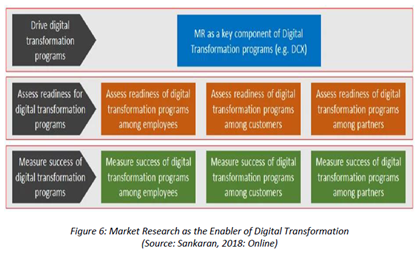
According to Keller (2023), many studies have indicated that gaining visibility into the customer experience is one of the biggest challenges on the digital transformation agenda. Market research has been a critical discipline in assessing and tracking customer experience. Deeper analytics of the customer experience post-purchase could assist the organisation in tracking the client’s satisfaction and acting quickly and precisely where improvements in service and product, including complex collaborative RID product development, are required.
Martin (2021: Online) answers the question: “What is the difference between market research and data science” by explaining that data science is an interdisciplinary field involved in analysing basic information to find statistical insights, informing business decisions, and noting that the role of the market researcher is almost identical. Successful organisations will harness the insight generated by the market research and data science teams and integrate the insights-finding mechanisms. This is critical to breaking down the barrier between market research and data science to allow the organisation to understand past behaviour and future predictions. Thus, organisations aiming to succeed must find a way to effectively merge teams to use fact-based quantitative, data-rich, emotive opinions.
Collaboratist leadership
The complexity of modern technologies, ie robotics, artificial intelligence, mass data, internet of things, integrating information technology and operations technology, etc calls for specialisation and sustainable collaboration among partner organisations and demands exceptional talents and well-educated human resources. Consequently, organisational design, development and governance have entered a challenging new phase (Steyn and Semolic, 2016).
In the Industry 4.0 economy organisations that experience an overall dearth of collaboratist leadership will have difficulty in maintaining and improving their levels of operational productivity and strategic benefit realisation. Steyn and Semolic (2020) aver that collaboratist leaders are super-transformational and constitute a shift away from old “motivations” of bureaucratic powers, towards inspiring people to believe in a vision of economic and social progress. This motivates people to abandon their own personal self-interests in favour of the organisation’s interests.
Building on the strengths of human capital means having a solid understanding of people’s behaviours, mindsets and their relationships.
Advantages stemming from creating dynamic open innovation virtual dynamic learning organisations (VDLOs) to achieve strategic success in Industry 4.0 complexity are clear but cannot be successful without a concomitant shift from bureaucratic to “smart” collaboratist leadership, the most profound dynamic capability element of modern-day organizations. Leadership has a strategy focus on the one hand, and a people focus on the other hand. Having a strategy focus is about positioning the organisation in the market environment. To ensure that value add in complex collaborative digitalisation RID projects is achieved beneficially in a responsible and ethical manner, collaboratist leaders optimally utilise the balanced scorecard and shape their role modelling in accordance with the eight dimensions of a psychological climate, inter alia, trust, support, innovation, cohesion and autonomy.
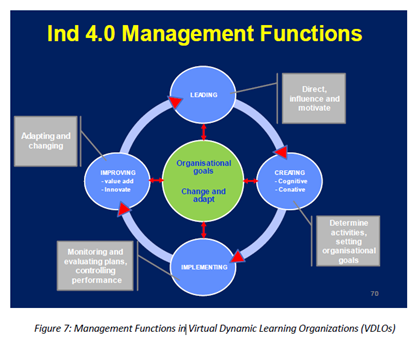
Moreover, leading and building on the strengths of human capital means having a solid understanding of people’s behaviours, mindsets and their relationships, and building their careers based on talents. With the dawn of Industry 4.0, society and business witnessed rapid technological developments that require higher levels of creativity and innovation, especially for doing complex collaborative digitalisation RID projects. The fourth industrial revolution economy has greatly impacted the way that organisations are led, managed and governed. Accelerated information flow and disruptive key enabling technologies (KETs) inspiring change, require rapid management decisions. In management functions of the Industry 4.0 economy (see Figure 7), leading takes up the prime position, followed by creating, implementing, and improving. Improving is the catalyst for innovation, and closely associated with the total quality management (TQM) component of innovative continuous improvement.
“Smart” collaboratist leaders are always committed to innovative continuous improvement in everything they do. This is an important dynamic capability and pillar of total quality management (TQM). Innovative continuous improvement is profoundly important for technology management, innovation management and knowledge management success. Moreover, the latter two elements are highly supportive of technology management, especially in complex collaborative digitalisation RID projects. In virtual dynamic learning organisations (VDLOs) employees are encouraged to continually identify and act upon opportunities to improve. This sustains the virtual dynamic learning organisation and encourages dynamic capabilities of double loop learning, systems thinking, creation of knowledge, and knowledge management.
“Smart” collaboratist leaders know that all functional and cross-functional process outputs in the organisation’s value chain must be measured by utilising appropriate key performance indicators (KPIs) that are linked to the critical success factors (CSFs) mentioned above. The results of the measurements must be appraised to assess to what degree strategic benefits are delivered. If an appraisal indicates that the strategic benefits do not accrue to a satisfactory degree, a review aimed at an innovative continuous improvement initiative follows. Hence, smart leaders who understand systems thinking also grasp the importance of adopting the balance scorecard as a component of their quality management system (QMS) in measuring the performance.
It is the task of executive leaders, who are responsible for the organisation’s strategic analysis, strategic development and strategy implementation, to introduce an effective learning and growth strategy. Leadership acumen and excellence are very important factors in achieving this. If absent it will cause the organisation to fail. Steyn and Semolic (2016) advocates the importance of having a Chief Portfolio Officer at the executive level to ensure effective leadership in Industry 4.0. The knowledge, skills, and behaviour of the human resources component in the organisation need also to be continuously improved to maintain a competitive advantage.
Collaboratist leaders know that the learning and growth perspective of organizational strategy is vital to the success of virtual dynamic learning organisations (VDLOs) engaged in complex collaborative digitalisation RID projects performed by the product development and commercialisation supply chain process. Moreover, collaboratist leaders who promote knowledge-based learning cultures and create 4.0 mindsets, are continuously focused on organisational transformation and change to sustain performance. A marked feature of VDLOs is their high levels of collaboration, coordination and integration of strategic analysis and development and strategy implementation.
Hence, super transformational collaboratist leaders facilitate organisational learning, rely to a large degree on autonomy, and in doing so encourage decentralised decision-making. Importantly, they focus on trustworthy supportiveness to win the commitment of the workforce and simultaneously raise their motivational levels as well as their innovative capabilities, while persisting to create a culture of continuous learning.
Collaboratist leaders balance their attention between actions that create progress and the motivation of virtual team members. They possess unique qualities suited to the Industry 4.0 economy, and act as mentors and coaches to team members by listening to their concerns and needs. It encompasses the need to respect and celebrate the individual contribution that each member in a collaborative virtual network of partners makes to the team. Well-directed diversity of team members gives it true strength.
Collaboratist leaders are visible and available to dynamically provide direction to virtual networks of partner project teams. They are master listeners, focus on identifying the needs of people instead of dictating to them, and empathise with others. This creates trust and support between the leader and the virtual project team members. Moreover, they have the skills to inspire and keep people motivated despite the complexity and high risk associated with digitalisation RID projects Industry 4.0 organisations are engaged in.
Conclusions
Complexity is found in all areas and levels of businesses and societies. Challenges of complex collaborative digitalisation RID projects need special attention. A culture of partnering and collaboration is essential for the effective and efficient digital transformation of industries, their business ecosystems and society.
The complexity of Industry 4.0 technologies and associated business models requires the holistic, interdisciplinary approach of stakeholder “partnership and collaboration” to achieve success. This is not happening to a satisfactory degree and the gap between individual professional disciplines that address Industry 4.0 issues in isolation is unfortunately still an overwhelming challenge.
Limited partnering and collaboration in research, innovation and development initiatives are much too prevalent. Instead of focusing on the challenges of bringing Industry 4.0 to a holistic conclusion in an integrative way (technological, organisational and behavioural), a search for new challenges of a dawning Industry 5.0 is preferred, such as emerging business models and organisational solutions triggered by 4.0 technologies. It is apt to conclude that these aspects are in fact an integral part of the transformation and change of the business environment and society of Industry 4.0.

1. Digitalization – is the use of digital technologies to change a business model and provide new revenue and value-producing opportunities; it is the process of moving to a digital business (Gartner Glossary, 2023)
2. How to cite this paper: Semolic, B. and Steyn, P. (2023). Management and Leadership of Complex Collaborative Digitalization Projects and Programs; PM World Journal, Vol. XII, Issue IV, April.
3. RID – RESEARCH (new theoretical knowledge search), INNOVATION (creation and pilot testing of novelties), and DEVELOPMENT (implementation and start-up of novelties commercialization).
4. Enabling Technologies – Equipment and/or methodology that, alone or in combination with associated technologies, provides the means to generate giant leaps in performance and capabilities of the user. For example, the coming together of telecommunication technologies, internet, and groupware has levelled the field so that even smaller firms are able to compete in areas where they otherwise could not (Business Dictionary, 2018)
Bibliography
Akamai (2019: Online)
HORSE Project Consortia (2015-2020), Smart integration robotic system for SMEs controlled by Internet of Things on dynamic manufacturing processes, Horizon 2020, Call: H2020-FoF-2015, funded by the EU Horizon 2020 RI program under grant agreement No 680734.
Jisc (2020: Online)
Keller, Tanya. 2023. “Maintaining Financial Services Sector Relevance and Sustainability in a Digitally Transforming Business Ecosystem”, in-progress PhD thesis, Cranefield College, South Africa.
Mataitsane (2019: Online)
ROBOTOOL – 1 Project Consortia (2019 -2021). New processes of cognitive and flexible robotized workplaces in toolmaking – The investment is co-financed by the Republic of Slovenia and the European Union from the European Regional Development Fund.
Saldanha T. 2019. Why Digital Transformations Fail: The Surprising Disciplines of How to Take Off and Stay Ahead, Berrett-Koehler Publishers, USA, July.
Semolic, B. 2018. Project Management 4.0 – the Integration Language of the Industry 4.0 Business Processes, 17th KM FEST, 10-11th September 2018, Odense, Denmark.
Semolic, B. 2022. Digitalization of Manufacturing Processes, DIGI-SI Project, LENS Living Lab, Celje.
Semolic, B & Baisya R.K./Editors/. 2013. “Globalization and Innovative Business Models”, IPMA & Anne Books Ltd. New Delhi, ISBN:978-93-8212-715-4.
Semolic B. & Co. 2011. International Collaborative Research-Innovation Program, Smart Machines & Systems, Project Charter, Version 1.1, LENS Living Lab, Celje.
Semolic, B., Semolic, L. (2021). Virtual Open Innovation System (VOIS) with the Case Study: Partnering Research-Innovation Project ROBOTOOL-1; PM World Journal, Vol. X, Issue VIII, August; pmwj108-Aug2021-Semolic-Semolic-virtual-open-innovation-system-with-case-study.pdf
Semolic, Brane and Steyn, Pieter. 2017. “Industry 4.0 Virtual Value Chains and Collaborative Projects”, PM World Journal, Vol. VI, Issue IX, September. https://pmworldlibrary.net/wp-content/uploads/2017/09/pmwj62-sep2017-Semolic-Steyn-industry-4.0-virtual-value-chains-featuredpaper-1.pdf; Republished in the Russian Project and Programme Management Journal, April 2019, Moscow.
Semolic, Brane and Steyn, Pieter. 2018. “Industry 4.0 Collaborative Research, Innovation and Development (RID) Projects”, PM World Journal, Vol. VII, Issue VIII, August.https://pmworldlibrary.net/wp-content/uploads/2018/08/pmwj73-Aug2018-Semolic-Steyn-Industry4.0-Collaborative-RID-Projects-featured-paper.pdf
Simmons M. 2018. Studies show that people who have high “Integrative Complexity” are more likely to be successful,https://medium.com/the-mission/studies-show-that-people-who-have-high-integrative-complexity-are-more-likely-to-be-successful-443480e8930c.
Steyn, Pieter. 2010. “The Need for a Chief Portfolio Officer (CPO) in Organisations”, PM World Today, Vol XII, Issue VII, July; https://pmworldlibrary.net/wp-content/uploads/2015/02/Steyn-2010-July-need-for-chief-portfolio-officer-featured-paper.pdf; Republished in the “Journal of Project, Programme, and Portfolio Management” University of Technology Sydney, Vol 1, No 1, Australia; Republished in the “Russian Project and Programme Management Journal”, October 2012, Moscow.
Steyn, Pieter. 2012. “Sustainable Strategic Supply Chain Leadership and Management”, PM World Journal, Vol. I, Issue V, December.https://pmworldlibrary.net/wp-content/uploads/2013/01/PMWJ5-Dec2012-STEYN-Sustainable-Strategic-Supply-Chain-Leadership-Featured-Paper.pdf
Steyn, Pieter and Semolic, Brane. 2016. “The Critical Role of Chief Portfolio Officer in Governing a Network of Partner Organisations in the Emerging Collaboratist Economy”, PM World Journal, Vol. V, Issue II, February.https://pmworldlibrary.net/wp-content/uploads/2016/02/pmwj43-Feb2016-Steyn-Semolic-Critical-Role-of-CPO-colloratist-economy-featured-paper.pdf
Steyn, Pieter and Semolic, Brane. 2017. “Collaboratism: A Solution to Declining Globalization and Rising Protectionism”, PM World Journal, Vol. VI, Issue III, March. (PMWJ Award-Winning Article for 2017).https://pmworldlibrary.net/wp-content/uploads/2017/03/pmwj56-Mar2017-Steyn-Semolic-collaboratism-featured-paper.pdf
Steyn, Pieter and Semolic, Brane. 2018. “Designing Industry 4.0 Virtual Networks of Partners Value Chains”, PM World Journal, Vol. VII, Issue V, Dallas, May.https://pmworldlibrary.net/wp-content/uploads/2018/05/pmwj70-May2018-Steyn-Semolic-industry-4.0-virtual-networks-partners-value-chains.pdf
Steyn, Pieter and Semolic, Brane. 2019. “Project and Program Management Acumen: The Catalyst for Industry 4.0 Organizational Success”, PM World Journal, Vol VIII, Issue VIII, September.https://pmworldlibrary.net/wp-content/uploads/2019/09/pmwj85-Sep2019-Steyn-Semolic-Steyn-project-and-program-management-acumen.pdf
Steyn, Pieter and Semolic, Brane. 2020. “Leading Virtual Dynamic Learning Organizations, PM World Journal, Vol. IX, Issue V, May.https://pmworldlibrary.net/wp-content/uploads/2020/04/pmwj93-May2020-Steyn-Semolic-Leading-Virtual-Dynamic-Learning-Organisations.pdf
Steyn P. & Semolic B. 2020. “Collaboratist Leadership in the Industry 4.0 Economy”, PM World Journal, Vol. IX, Issue V, ISSN: 2330-4480.https://pmworldlibrary.net/wp-content/uploads/2020/04/pmwj93-May2020-Steyn-Semolic-Leading-Virtual-Dynamic-Learning-Organisations.pdf
Steyn P. & Semolic B. 2022. “Knowledge Management and Project-Based Knowledge Creation”, PM World Journal, Vol. XI, Issue XI, November.
Tepes M., Semolic B. & All. 2011. Tool Making Factory of Future- innovative business models and the concept of intelligent e-tools, 11th International Conference in Management of Innovative Technologies, TAVO, Fiesa.
Alexis Knipe
Show SEO & AI-citation metadata for this article
DemoEvery article carries this structured metadata so it surfaces in search and can be cited by AI answer engines. In the back end, a person posting fills these in, or the AI layer drafts them.