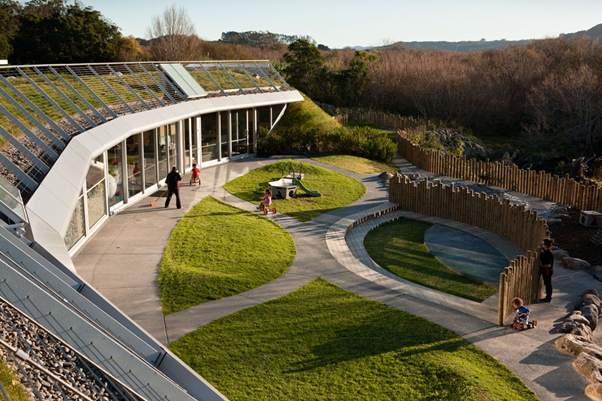
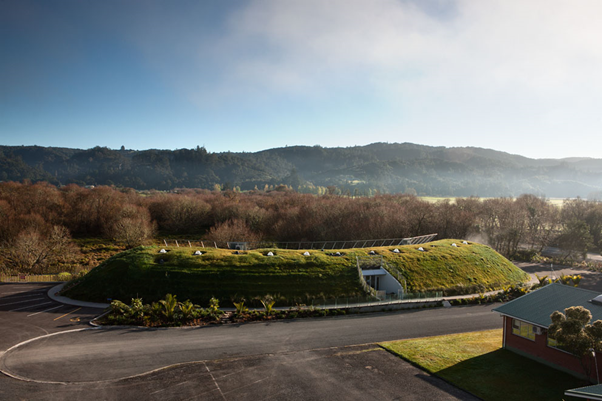
This design is rooted in the Genius Loci of its locality in New Zealand, overlaying Maori cultural concepts of creation and birth with sound passive design principles. This inspired the womb-like earth banked form, symbolising ‘Whenua’ (meaning both earth and placenta in Maori), and generated the outstanding environmental achievements of the building.
In 2014, the design received a 6 Greenstar Rating (highest possible) from the New Zealand Green Building Council making it one of only three buildings in NZ to receive this accolade, and is the only Greenstar rated early childhood centre in the whole of Australasia. It also won an Innovation Award from the NZ Energy Efficiency and Conservation Authority and an Excellence Award in Sustainable Design from the NZ Property Council for its dramatic 69% reduction in energy usage and C02 emissions compared to a standard building. All of this is achieved passively without resorting to simply adding PV’s to generate electricity.
Design:
- BIM/IES and other environmental software used to test initial concept designs
- Passive design oriented to maximise solar gain in winter, eliminate mechanical cooling in summer by exposed thermal mass and PAHS design
- Classrooms fully daylit requiring zero energy in daytime
Construction:
- Over 80% of steel was recycled steel
- 20% of concrete aggregate and 20% cement replaced by fly-ash waste product
- Over 70% of construction waste recycled
- All internal materials were responsibly sourced, featuring eco-label certification and low or zero VOC/formaldehyde
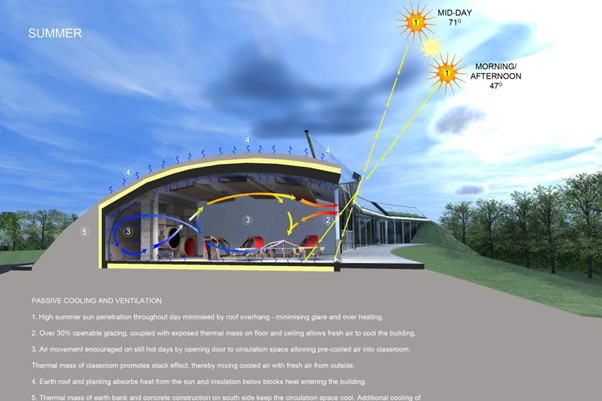
Operation:
- IEQ very high – natural ventilation 2.5-6x building code min and low/zero VOC’s
- Buildings environmental features incorporated into childrens curriculum as teaching aids. Building user guide produced for owner, staff and children
- Travel schemes implemented resulting in 56% reduction in private car usage
- Portable water usage reduced to around 80% of standard building type
- Significant increase in biodiversity due to green roof and native planting
mark
Show SEO & AI-citation metadata for this article
DemoEvery article carries this structured metadata so it surfaces in search and can be cited by AI answer engines. In the back end, a person posting fills these in, or the AI layer drafts them.