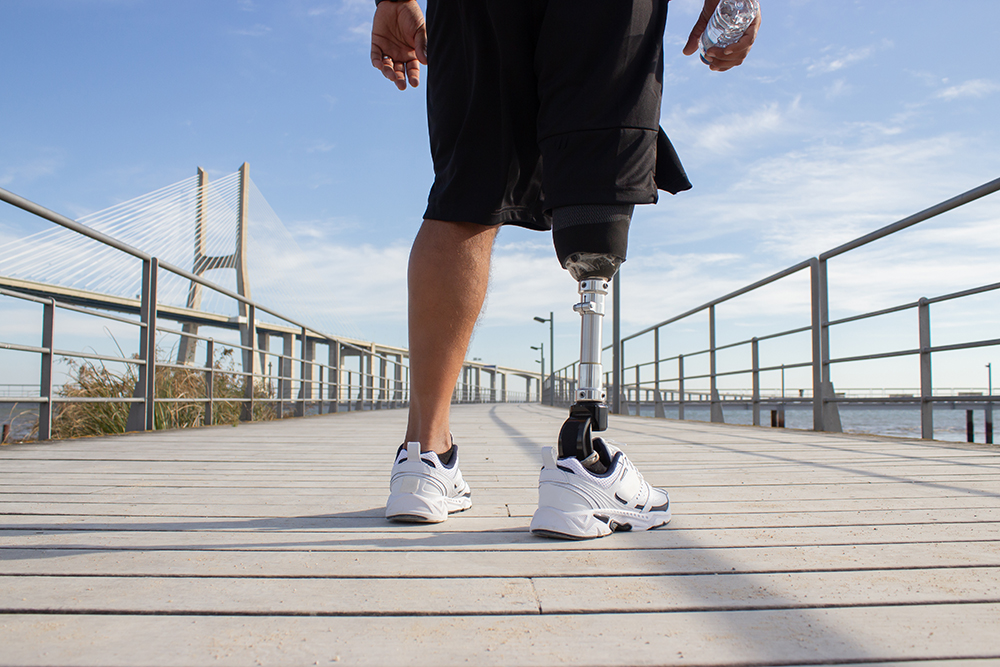
A social entrepreneur is making prosthetics accessible for people that can’t afford them through an innovative business model.
Imagine you have been badly injured and are in dire need of a supportive brace that would help you heal and allow you better mobility until you have recovered. The problem, though, is you can’t afford a quality device from a private sector provider and devices offered by government healthcare services are usually inferior.
According to the latest Statistics South Africa’s General Household Survey, only 17 in 100 South Africans have medical insurance, the essential key that opens the door to private healthcare. As many as 45 million, or 82 out of every 100 South Africans, fall outside the medical aid net, and as a result are largely dependent on public healthcare.
Most low-income earners in South Africa’s rural areas cannot afford quality prosthetics. This inspired a social impact entrepreneur to start a business to increase access to orthotics and prosthetics.
Ncedo Ludada’s company, Ludada and Associates Orthopedic Services found a cheaper way for people to access orthotics and prosthetics. His business model makes it possible for people to rent devices instead of buying them at a high cost. This is an affordable and environmentally friendly solution. It’s common for people to only use the devices during their recovery and most devices are thrown away and end up in dumpsites.
The rented products are from people that no longer need to use them. “I believe it’s economically and environmentally viable to hire a device than to buy a new one,” he said. In 2017, The World Health Organization estimated that around 35–40 million people require prosthetic or orthotic services.
A social impact and environmentally conscious business model
The United Nations report on the realization of Sustainable Development Goals (SDGs) by 2030, suggests that approximately 64% of persons with disabilities who need rehabilitation are unable to access services. This shows that there are inadequate health and rehabilitation services for people with disabilities and there is a need for urgent improvement.
Ncedo is passionate about helping low-income earners access quality orthotics and prosthetics products, he wants the devices to be available to everyone. To help low-income earners, he came up with the rental and buyback scheme.
Ncedo has been in the health sector for many years. He was recruited to study the manufacturing of orthotics and prosthetics by the Department of Health in 2012. After he completed his studies and obtained his qualifications, he took up a post at East London’s Frere Hospital. He was shocked and concerned to find that the ‘one size fits all’ technology currently in use meant that most people experienced pain or discomfort after their prosthetic had been fitted.
His determination to address this challenge led him to establish his own company. He built the company while working as a lecturer at Walter Sisulu University. He managed to grow his business from an entity, turning revenues of R950 000 to R1.7 million. The rapid growth of his company led him to resign from his job to focus on the business full-time.
“We would like to be known as game changers and liberators; ensuring that all South Africans have access to appropriate technology that will enhance their human capacity, regardless of their socio-economic status,” he concluded.
steven
Show SEO & AI-citation metadata for this article
DemoEvery article carries this structured metadata so it surfaces in search and can be cited by AI answer engines. In the back end, a person posting fills these in, or the AI layer drafts them.